

 Agriculture
  Automotive
  Building & Construction
  Electrical & Electronics
  Home, Sport & Leisure
  Packaging
  Textile & Fibers


Tosaf’s experts delve into the specifics of gloss reduction in polycarbonate/PMMA sheets & profiles
In recent years, there has been a growing demand to reduce the gloss on PMMA and polycarbonate (PC) sheet surfaces. This demand is fueled by aesthetic preferences, alongside a widespread acknowledgment of the value of minimal sunshine glare in large-area roofing projects.
Selecting and implementing the right polycarbonate and PMMA anti-glare requires an acquaintance with many production parameters. The following article addresses a variety of topics, including differences in AG quality, the pros and cons of common production methods, ways for measuring AG effects, and much more.
Multiple Terms, One Meaning: Understanding the glossy vocabulary
Various terms are used to describe products that have undergone treatment to significantly diminish gloss from polished sheet surfaces, including “anti-glare,” “non-glare,” “anti-reflective,” “matte,” “matte-finish,” and “satin”. It appears that every producer selects a preferred terminology for products with lower gloss; furthermore, it has become common practice for extrusion companies to use different names for the same product type. Naturally, this can cause confusion. From our experience, awareness of this phenomena can reduce the sense of disorientation.
The impact of quality of treatment
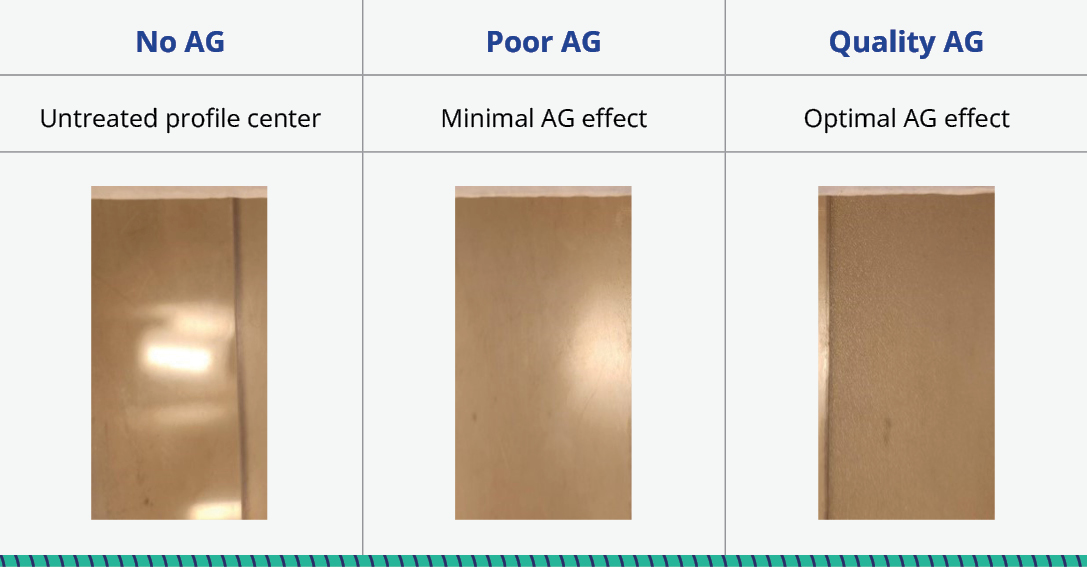
Anti-glare (AG) treatments can vary in quality and effect. Many manufacturers experience frustration when their AG treated profile fails to meet their anti-glare expectations. This often occurs due to selecting a misguided profile treatment. Choosing the right AG treatment is essential to achieving the expected results.
Below are some examples of polycarbonate profiles with AG.
AG sheet production techniques: The pros and cons
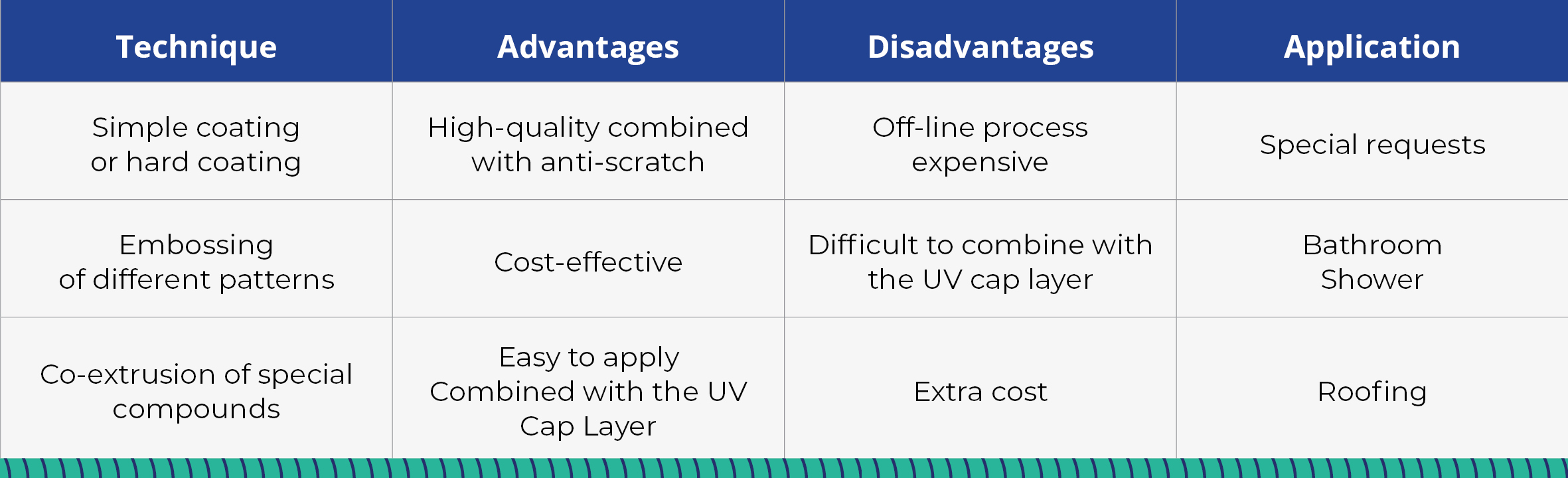
AG sheets are produced using three primary techniques. Each technique has advantages and disadvantages. Below is a summary of these techniques, their typical applications, and their benefits and liabilities:
Measuring the AG effect
To ensure consistent anti-glare (AG) quality, it is essential to use a reliable tool for measuring gloss levels. This is critical not only during the development phase but also throughout regular production, as part of quality control. The production conditions for PC/PMMA sheets have a significant impact on the final gloss level. Even with the same AG compound, different processing parameters can result in varying gloss levels. This variation is primarily due to the sensitivity of gloss to the pressure exerted by the chilling rolls while the sheet is still in a molten state.
A simple method for assessing gloss quality is to compare the product under a light with a “standard” reference. However, this approach is not precise, especially when specific gloss measurements are required.
A more accurate and professional way of measuring gloss is using a portable glossmeter. Known as a highly cost-effective tool, a portable glossmeter is usually priced between €200-€500.
A glossmeter measures the specular reflection of light from a surface. After projecting a beam of light onto the surface at a fixed intensity and angle, the glossmeter measures the reflected light at an opposite angle. Gloss can be measured at three different angles, and it is crucial for sheet producers to specify the angle used when reporting gloss levels.
Selecting the right angle for gloss measurement
Gloss levels on surfaces are typically measured using standard angles described in ISO 2813 and ASTM D523. These standards define three angles for measuring gloss, depending on the surface’s gloss level:
1. Universal Measurement Angle – 60º:
The standard angle is used to measure all gloss levels. It serves as the reference angle.
2. Low Gloss – 85º:
For surfaces with gloss levels lower than 10 GU (Gloss Units) when measured at 60º, a grazing angle of 85º provides improved resolution. It is also effective for averaging gloss on uneven or textured surfaces.
3. High Gloss – 20º:
For surfaces with gloss levels above 70 GU, an acute angle of 20º offers enhanced resolution. This angle is sensitive to haze effects, which can affect the surface’s appearance.
Valuable production process tips
The following recommendations can come in handy for sheet and profile producers who wish to meet the growing market demand for low-gloss products, while optimizing their production efficiency and cost-effectiveness:
- Don’t neglect the texture factor: When producing profiles and sheets, it is essential to select the most suitable technique for achieving the desired AG effect. But keep in mind that in addition to gloss levels, the texture of the AG treatment can vary significantly, from fine to rough surfaces, affecting the product’s overall appearance.
- Combine AG and UV: One of the most common production techniques involves using an anti-glare compound, which is frequently combined with UV absorber protection. This dual approach allows producers to apply both UV cap layers and AG effects in a single process, thus reducing costs and simplifying the extrusion process.
- Ensure thermal stability: AG compounds are based on cross-linked polymeric beads, which differ in particle size, size distribution, polymer type, and thermal stability. Remember: ensuring thermal stability is especially crucial for maintaining a stable extrusion process.
If you have any questions, we’d love to hear them. Please get in touch with us:
Gabi Bar: [email protected]


